The aperture determines how much light the lens should emit, but as a side effect, it also affects the depth of field. If you have a great value on the aperture (e.g. f / 22), it will let little light go through but it will gives a great depth of field, while you have a small aperture value (ex f / 2.8) so will it be a lot of light but gives a little depth of field.
But when the camera emits little light, the exposure times will be long, and a lot of light and it will be short.
This means that you get very dependent on weather conditions. If you want to get photos of wide views on free hand, it will be difficult in cloudy weather when the exposure times get long.
If you want to photograph fast movements, you need short times and then the aperture value becomes small. Lenses with good quality usually have possibility to low values of aperture as they have good lenses and do not steal much light. Zoom and telephoto lens always take some extra light and you lose a little in possible aperture values.
I usually have my camera set to automatic time and manual aperture setting, then I decide on aperture (what depth of field I want), and the camera itself lets out the time. Should time now be less than 1 / 30th second, which is very difficult on freehand, I can compromise on the depth of field and decrease the aperture value slightly.
Below are two examples of the effect of the aperture, because it is the one that affects the depth of field, the different times are because they will not be over / underexposed
 aperture value f/2.8, tid 1/100 sec.
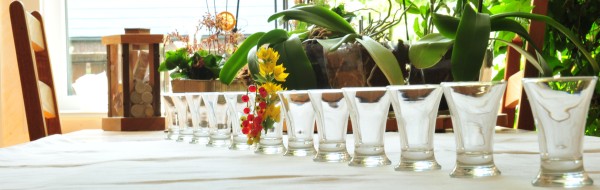 aperture value f/22, tid 1/2 sec.
I found that the top picture is much nicer and more effective as it emphasizes the flower and the berries (however, you may think of why I have take a photo of shot glasses with flower and red berries, but in my defense I want to say that it is for demonstrative purposes ). What I want to show is that depth of field can be used as an enhancing effect, which is best due to motives and situations.
Fast progress requires short times that automatically lead to a smaller aperture value.
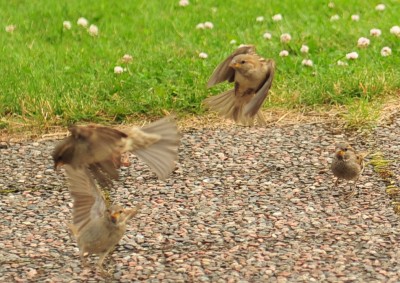
short shutter speed, 1/1250 sec.
(To top it all; it was cloudy, otherwise I could have taken the picture with bigger
aperture value than f / 2.8, now the two birds on the left did not come in the depth of field)
Tip: Use camera mode so that you decide aperture value, but make sure that the exposure time does not go too long.
PS: It’s perfectly OK to get a mental meltdown when you’re thinking about aperture value. Large aperture value = small hole = wide depth of field = long times, so if you say “I had large aperture” it is the hole size or aperture value that you mean. Therefore, it is always best to use the term aperture value, because then there will be no misunderstanding.